AquaReject™
A self-cleaning 0.01-micron membrane at your kitchen sink. It rejects contaminants instead of absorbing them — so nothing accumulates, nothing is wasted, and there is no cartridge to swap every three months.
Reject, don't absorb
Almost every home filter works by absorption: water passes through carbon or a fine mesh, and contaminants get trapped inside it. That means the cartridge is a slowly filling reservoir of everything it has caught — bacteria grow in it, and as it saturates it begins to let contaminants through. You replace it on a schedule because nobody can tell when it has failed.
AquaReject works the other way. Water flows across a tubular membrane with 0.01-micron pores. Clean water passes through; everything larger is swept along the membrane surface and out to your ordinary sink faucet, where it is fine for washing dishes. The membrane cleans itself with every gallon, so it does not plug, does not accumulate, and does not need replacing. The only consumable is a carbon polish for chlorine, changed once a year.
Compared with what's under most sinks
Pitcher filters, countertop reverse osmosis (including AquaTru-style units), whole-house systems, and bottled water each solve part of the problem. Here is where they differ.
| AquaReject | Pitcher / countertop carbon | Countertop reverse osmosis | Whole-house filter | Bottled water | |
|---|---|---|---|---|---|
| Removes bacteria and viruses | Yes — 0.01 µm membrane | No | Yes | Generally no (10 µm media) | Depends on source and storage |
| Removes lead, rust, particulates | Yes | Partially, until saturated | Yes | Coarse only | — |
| Keeps natural minerals and fluoride | Yes | Yes | No — strips everything, then may add back a synthetic blend | Yes | Usually no fluoride |
| Water wasted | None — reject stream goes to your sink for washing | None | Several gallons to the drain per gallon made | Backwash cycles to drain | None at home; heavy in production and trucking |
| How it fails | It doesn't plug; performance is stable | Silently, as media saturates; bacteria grow in the cartridge | Membrane and cartridges exhaust | Plugging, leaks, scale, pressure loss | Plastic leaching, heat, storage time |
| Consumables | One carbon cartridge a year (about $75–125) | New cartridge every 2–3 months | Filter set every ~1,200 gallons | Media, valves, service calls | Every bottle |
| Storage tank | None — flows on demand | Pitcher | Usually a tank | None | The bottle |
| Cost over 5 years | About $3,000 including install and consumables | $300–600 | $500 unit plus roughly $2,000+ in filters | $5,000–12,000 plus service | $2,000–5,000 for a household |
Prove it before you buy it
Most people install a filter, notice the water looks clear, and never learn what actually changed. We would rather you measure it. Before purchase we bring a portable AquaReject to your home, treat your water, and hand you samples of untreated and treated water to send to a lab of your choosing — pH, bacteria, total organic carbon, heavy metals, whatever you want tested.
When you buy, we reimburse up to $250 of that analysis. The before-and-after report is yours to keep.
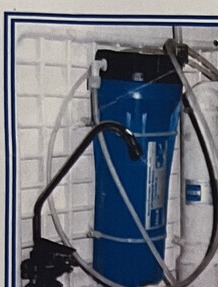
An early AquaReject installation from Sam's EPS days. Current units use the same self-cleaning tubular membrane in a similar footprint.
Hard water or well water?
Where scale is a problem, we add a Sidon inline conditioner on the incoming supply (from about $3,000) ahead of AquaReject. It reduces scale on fixtures and protects the membrane without chemicals or maintenance. A combined installation runs around $6,500 plus plumbing.
Questions about AquaReject
I already paid for a whole-house filter. Why add something at the sink?
Whole-house systems are built for flow, not fineness. Their media is typically 10 microns, which stops sand and rust but passes bacteria, viruses, dissolved metals, and most chemicals. They also backwash on a timer, sending water to the drain, and need ongoing service. AquaReject sits at the one tap you drink and cook from and handles what the big system cannot. Its only upkeep is a yearly carbon cartridge.
My countertop carbon filter has a light that tells me when to change it. Isn't that enough?
The light counts gallons; it cannot see what is in the water. Carbon absorbs some pollutants and then hosts them — the green film that appears in the reservoir is bacteria growing on what the cartridge has collected. Absorption also runs out unpredictably depending on what came through your pipes that month. Rejection does not have that problem: contaminants never enter the media, so there is nothing to saturate.
Countertop reverse osmosis with an alkaline stage costs under $500. Why pay more?
The unit is cheap; the filters are not. A typical countertop RO filter set is rated for about 1,200 gallons — at ten gallons a day that is a replacement every couple of months, which adds up to well over $2,000 across five years. RO also strips every mineral and the fluoride that protects teeth, then some units add a synthetic mineral blend back in. AquaReject makes up to 1,200 gallons a day with no per-gallon cost, keeps natural minerals, and is warranted for five years.
I have an under-sink reverse osmosis unit. Should I switch?
If wasted water is not a cost where you live, and you are comfortable with demineralized water or a re-mineralizing cartridge, your RO unit will keep serving you. The reasons people switch are the drain line — several gallons wasted for every gallon made — the mineral question, and the storage tank, where water sits between uses.
Why not just drink bottled water?
Bottled water is only as good as its source, its plastic, and its storage — it sits in tanks and trucks for months, often in heat. It contains no fluoride, it costs more every year, and almost nobody cooks with it. AquaReject gives you the same protection at the tap, for drinking and cooking, with nothing to carry home.
My city already has a large reverse-osmosis treatment plant. Why filter again at home?
Because the water travels miles from that plant through old steel, asbestos-cement, and plastic mains before it reaches you. Pipes corrode, break, and get tapped for new connections, and contaminants enter along the way. A point-of-use filter is the only step that treats the water after the last pipe.
What exactly does it remove — and what does it leave in?
The 0.01-micron membrane rejects bacteria, protozoa such as Cryptosporidium, viruses, rust, sediment, and particulate lead and iron, and Sam's testing shows substantial removal of organic contaminants including solvents and oils. The carbon polish removes chlorine taste and odor. Dissolved minerals and fluoride pass through. If you are concerned about a specific contaminant, such as PFAS or mercury, ask us — the demonstration and lab analysis exist precisely so you can check your own water rather than take anyone's word for it.
Why are ARMS and AquaReject on the same website?
Both are about protection at the source. ARMS protects the outside of the home from fire and keeps the landscape alive. AquaReject protects what you drink from whatever arrived through the pipes. Same engineer, same membrane thinking, two different threats.
See it work on your water
Tell us where you live and what your water is like — city or well, hard or soft, anything you have noticed. We will arrange a demonstration and a sample for analysis.